Introduction
In most programming languages, any function can reach out and touch the world: read the clock, write a file, open a socket. But ambient access to state—through singletons, globals, built-in functions, and system calls—makes testing brittle and reasoning murky. You run a test once and it passes; run it again and it fails because the clock advanced or a temporary file wasn’t deleted. You call out to a small math library and it exfiltrates your SSH keys because it had access to your home directory.
Dependency injection [Fowler 2004] can help tame access to state: don’t let code reach out for resources; pass them as parameters instead. What if a language took dependency injection to its logical conclusion, making it a semantic property of code rather than a design pattern? Then all system resources would have to be injected—for example, as parameters passed to main.
| |
Here, main is a hermetic function:
A function is hermetic iff it does not access existing state except through its parameters.
If main is hermetic, then any function it depends on must also be hermetic—otherwise main is indirectly accessing existing state. So a hermetic main eliminates ambient authority [Yee et al. 2003] by requiring all capabilities to be explicitly passed as parameters. This aligns with the defining discipline of object-capability languages [Miller 2006], where authority over state is conveyed by explicit, unforgeable references. If both “dependencies” and “authority” are taken to include any stateful resource, then “inject all dependencies” and “explicit capability passing” become the same language property. That property is obtained by making main hermetic.
In a hermetic programming language, function parameters act like hermetically sealed channels through which all access to state flows. Whether writing to a file, reading a channel, or mutating a buffer, the caller controls the world the function can see. Deterministic time? Pass a fake clock. Capture standard output? Pass a mock console. Every potential access to state is visible at the call boundary. Function signatures become dependency manifests. No hidden inputs. No undeclared effects.
The Purity Gap
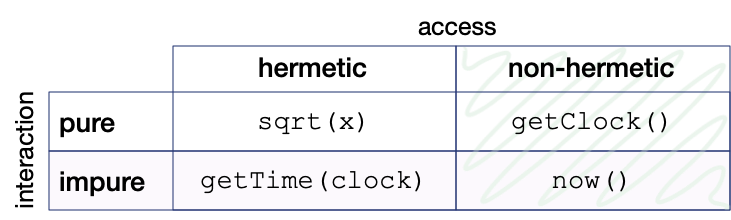
Hermeticity is a semantic property of functions, similar to purity. But hermeticity is not just purity-lite. Purity restricts interaction with state, while hermeticity restricts access. These are orthogonal.
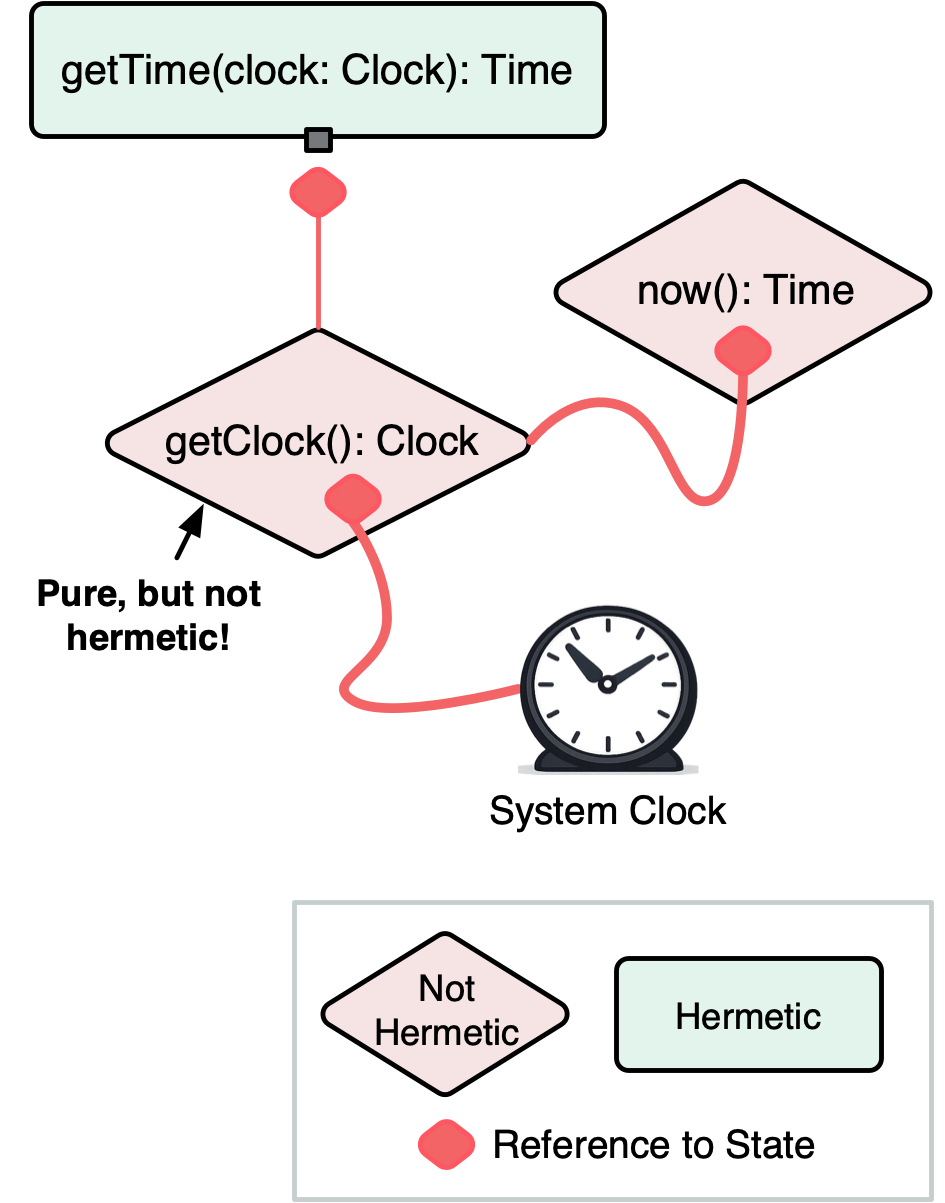
Suppose the function getClock(): Clock returns a global opaque handle to the system clock. getClock is pure: it has no effect on the clock, and because it always returns the same constant, it is referentially transparent.
Now suppose the function getTime(clock: Clock): Time takes a Clock—either the real clock or a mock—and returns that clock’s time. The current time can then be obtained from the system clock by calling getTime(getClock()).
getTime is hermetic because it accesses no state other than the clock passed as a parameter. getClock is pure. But the composed function now = getTime ∘ getClock is neither hermetic nor pure.
How is that possible?
Because getClock, while pure, is still tainted by access to ambient state. By returning a reference to the real clock, it exposes that state.
Interaction vs Access
now and getClock are both hard-wired to state: they access the system clock, and that access cannot be redirected by passing a different parameter.
getTime, by contrast, parameterizes its access to state: it is hermetic.
It is interaction with state that makes a function impure, not access. The most widely accepted definition of purity is referential transparency: an expression can be replaced by its value in any program context without changing observable1 behavior. A function fails referential transparency when evaluation interacts with observable state: either it affects state, or it is affected by state and so can return different results for the same inputs.
So hermeticity is both more and less strict than purity. A hermetic function may interact with the world as long as it is not hard-wired to it. A pure function may be hard-wired to the world as long as it does not interact with it.
Now, to understand the benefits of programming with hermetic functions, and the implications for libraries and language design, we first need a more precise vocabulary for how functions expose access to state.
Live and Inert Values
getClock exposes state by returning a handle. A function could also expose the same handle by writing it to a channel or storing it in a mutable data structure. In any case, what is exposed is a value that provides access to state.
A value that provides access to state is live.
Live values can include object references, handles, primitives, closures, and anything that embeds any of these and thereby provides a path to state.
Values that do not provide access to state are inert.
Providing Access to State
Providing access to state is different from merely designating state. A filename, for example, does not by itself provide the ability to interact with the file system. A function that receives a filename would still need to reach out to some library or builtin such as open, in which case open is the live value.
Intuitively, a value is live if the interactions it enables can be redirected by swapping it for a mock backed by caller-controlled in-memory state. In Appendix D, I formalize this as the Mockability Test.
In languages with well-defined notions of objects and references, the live/inert distinction can often be characterized in terms of object-graph reachability. For example, Joe-E’s immutable objects are inert by construction: they are immutable, and no mutable object or external state is reachable from them.2
Functions as Values
We can talk about functions in two roles: as code (callable), and as values (passable or storable).
A function is hermetic as code exactly when it is inert as a value.
An inert function does not provide access to state, so passing it to another function cannot provide that function with access to state. Conversely, a non-hermetic function is live.
A function is live iff its definition embeds a live value; specifically, it must contain a live free identifier, where a free identifier is any name appearing in a function definition that is not a parameter or local variable.
Consider the two Python functions below:
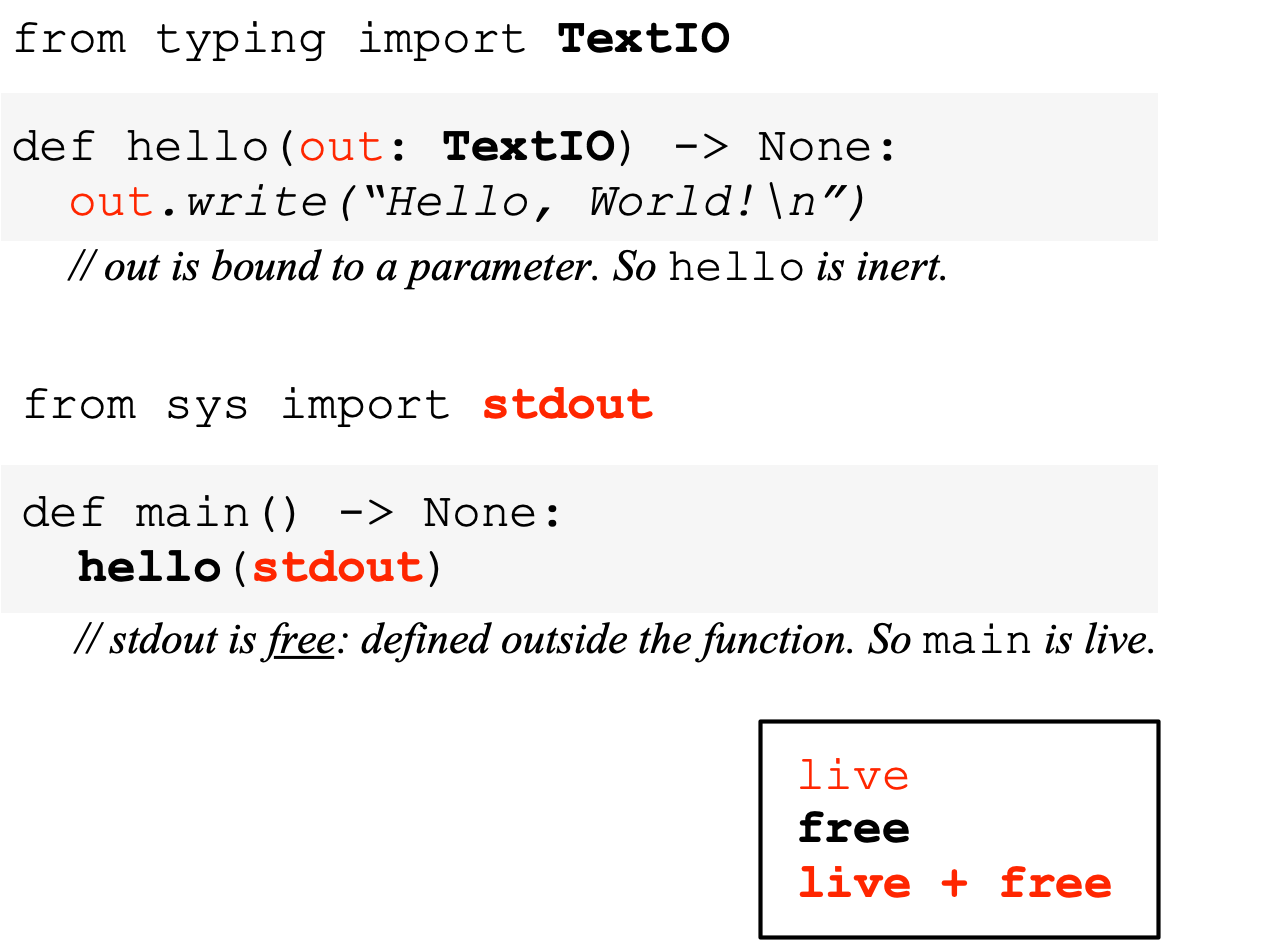
The only lexical name that hello references is the parameter out (write is a member selection on out), so hello is inert. In contrast, main is live because it refers to the live free identifier stdout.
Hermetic Programming Languages
There are two sources of live free identifiers in a language:
- ambient identifiers: globals, imports, builtins, primitives
- captured environments: closures
Inert Ambient Scope
Ambient identifiers are names available to all functions and modules by default: preludes, built-in functions, default imports, global constants, system calls, and so on. Collectively, these form the ambient scope.
A hermetic programming language implies an inert ambient scope.
If the ambient scope contains even one live identifier, then any function can reach out and access ambient state.
Inert Packages
This means that imports must not introduce live values into ambient scope, nor have observable side effects during initialization. In that sense, all packages must be inert.
Package-scoped functions and values therefore cannot capture live values from other packages.
| |
Here, Log is live because it captures the live free identifier os.Stdout.
Packages also cannot host global singletons; package-level globals and exported values must be inert.
Inert packages can, however, export hermetic constructors that mint fresh state without accessing existing state. They may also export inert types, interfaces, methods, and other definitions for complex data structures and algorithms. They may even provide logic for interacting with external resources such as databases or web services, as long as access to those resources is passed as parameters.
In a hermetic programming language, the standard library defines interfaces to system resources such as the filesystem, network, and clock, but actual access happens only through injected parameters. Many existing libraries implement this pattern: Go’s http.Serve accesses the network through its net.Listener parameter, Rust’s cap_std routes I/O through capability values, and Python sans-I/O libraries such as hyper-h2 go further by factoring I/O out entirely [Go net/http docs; cap-std; Benfield 2017].
Closures
An inert ambient scope prevents functions from capturing live ambient identifiers. But it does not prevent closures from capturing live local identifiers. Making all functions hermetic therefore additionally requires eliminating live closures.
So languages face a design choice:
Allow live closures: higher-order function values may carry captured authority. This may be desirable in languages where partial application and higher-order functions are idiomatic.
Take the closures-as-objects view: a closure with a hidden environment is treated not as a function value, but as an object with a hermetic
applymethod.3
Hermetic Language Properties
The defining requirement of a hermetic programming language is a hermetic main function, whether or not it is literally called main.
An inert ambient scope forces main to be hermetic. Conversely, if main is hermetic, then any live identifiers in ambient scope are necessarily unused.
Hermetic Programming Language = Hermetic Main Function ≈ Inert Ambient Scope
This still leaves one possible source of non-hermetic function values: captured local environments.
All Functions Hermetic = Hermetic Programming Language + No Live Closures
Hermetic Programming Benefits
Behavioral Referential Transparency
For pure functions, referential transparency means that f(x) depends only on the value of x (and the definition of f). Behavioral referential transparency extends this idea to stateful inputs: f(x) depends only on the observable behavior of x. There are no hidden inputs.
This facilitates local reasoning: minimizing the things a programmer must keep in mind to understand a fragment of code.
Pure functional programming achieves a particularly strong form of local reasoning by eliminating interaction with state entirely. But hermeticity also improves local reasoning by reducing the splash radius of possible interaction to the state reachable through explicit function parameters.
For example, suppose I pass a mutable list to a hermetic function:
| |
If f is hermetic, the only state it can access is the list referenced by x. It cannot consult a global, log to a singleton, or touch the clock. To understand f(x), the only state I need to think about is the content of that list.
Composability
Purity composes: if f and g are pure, then f ∘ g is pure.
Hermeticity composes too. Hermetic functions cannot grant one another access to existing state. So if f and g are hermetic, then f ∘ g is hermetic.
This means large programs can be assembled from small pieces that remain hermetic all the way up to main.
Testability, Determinism, and Portability
Hermeticity improves testability because stateful dependencies are already explicit and can be replaced with mocks without additional refactoring. It improves determinism because sources of variation—clock, RNG, network, filesystem, environment—must be passed explicitly and can therefore be replaced with deterministic alternatives. And it improves portability because hermetic code has no hard-coded environmental dependencies: it can be reused across execution contexts such as plugin systems, browsers, or smart contracts without depending on a special sandbox merely to prevent ambient access.
Security
Finally, hermetic programming changes the application’s trust model. By forcing authority to enter only through explicit interfaces, it naturally aligns with the core discipline of capability-based security, which I explore next.
Capability-Based Security
Today, we routinely download thousands of transitive dependencies through package managers like npm or cargo, trusting that none have been compromised. Because most languages grant ambient authority to the network and filesystem by default, an attacker who hijacks a package can silently exfiltrate environment variables, SSH keys, or database credentials.
But why should a random math library have access to your filesystem?
One of the core ideas of capability-based security is the elimination of ambient authority: those pernicious “pools of authority on which viruses grow” [Miller and Shapiro 2003]. In a language without ambient authority, untrusted code simply cannot access the network or disk unless it was explicitly given the capabilities required to do so. This also helps limit the surface of arbitrary-code-execution attacks.
Hermetic programming languages enforce the “no ambient authority” rule as a semantic language property.
Live Values Are Capabilities
Since a hermetic function by definition may access existing state only through its parameters, access to existing state cannot be obtained by forging references. Receiving a live parameter must be the only way a function can obtain authority over existing state.
In a hermetic programming language, live values are capabilities.
Delegation, Revocation, and Confinement
“Ambient authority” is sometimes taken to mean only ambient access to system resources. But if a function can communicate through a pre-existing channel, or write a live value into existing mutable state for later retrieval, then authority can flow between calls without appearing in the signature.
A hermetic programming language rules that out by eliminating ambient authority to any existing state. A hermetic function does not have its own memory; it can only delegate authority through channels explicitly provided by the caller.4 If a function is never given the authority to write a capability into existing state—a way of exposing state that I call grafting—then the authority it receives remains overtly confined5 to that unit of work and is automatically revoked [Yee et al. 2003] once the function finishes its work.
These are not extra security mechanisms: they follow from the core semantics of hermetic functions.
Principle of Least Authority
Eliminating ambient authority does not prevent programmers from granting too much authority. If main(world) is injected with an object containing world.clock, world.network, and so on, it can still pass that “god object” down through the call stack. This may be hermetic, but it is poor security hygiene.
The principle of least authority (POLA) [Miller 2006] dictates that main should ask for—and the host should grant—only the capabilities the program actually needs. In a hermetic language, the signature of the program’s main function acts as a dependency manifest, and capability-oriented interface standards such as WASI [WASI] can be used as a portable vocabulary for expressing those dependencies.
POLA also requires attenuating capabilities before passing them onward [Miller 2006]: pass a single file handle instead of the whole filesystem, and make it read-only if possible.
The same principle applies to meta-authority: authority to delegate or persist authority. Even in a hermetic language, a function can communicate or remember a capability by grafting a live value into mutable state broad enough to hold live values.
| |
In this example, any code that reads ctx now has database access.
A more secure design would attenuate the capabilities provided not just by db but also by ctx, wrapping ctx to make it read-only or restricting the types it can store.
Hermeticity and Ambient Authority
Although a hermetic programming language has no ambient authority, the converse is not true: a language can have no ambient authority without being hermetic. Hermeticity corresponds to a stronger capability discipline: authority must flow explicitly through capabilities passed as references or parameters.
A capability-secure language can also introduce authority through ambient endowment. For example, SES compartments have no ambient authority by default, but the host can endow them with live globals or modules [Endo SES]. WASI likewise provisions capabilities through imports. In both cases, authority is supplied by the host through ambient names rather than through function parameters.
By contrast, in Joe-E, explicitly propagated references are the only things that convey authority; the universal scope provides no authority [Mettler et al. 2009; Wagner 2007]. This maps closely to what I call an inert ambient scope. In that sense, Joe-E can be classified as a hermetic programming language.
Hermetic Programming in Pure Functional Languages
You might think hermeticity is irrelevant in a pure language. If functions cannot have side effects, why worry about access to state?
Because pure values can still be live.
Effect Values Can Be Live
In Haskell, an IO () describes an effectful computation [Peyton Jones 2001]. Constructing it has no side effects, but when interpreted by the runtime it interacts with state.
| |
Here, main is a pure value. But it is live in this essay’s sense because it is already committed to the real console instead of receiving console access as a parameter. It already embeds authority to interact with existing state.
Pure does not imply inert.
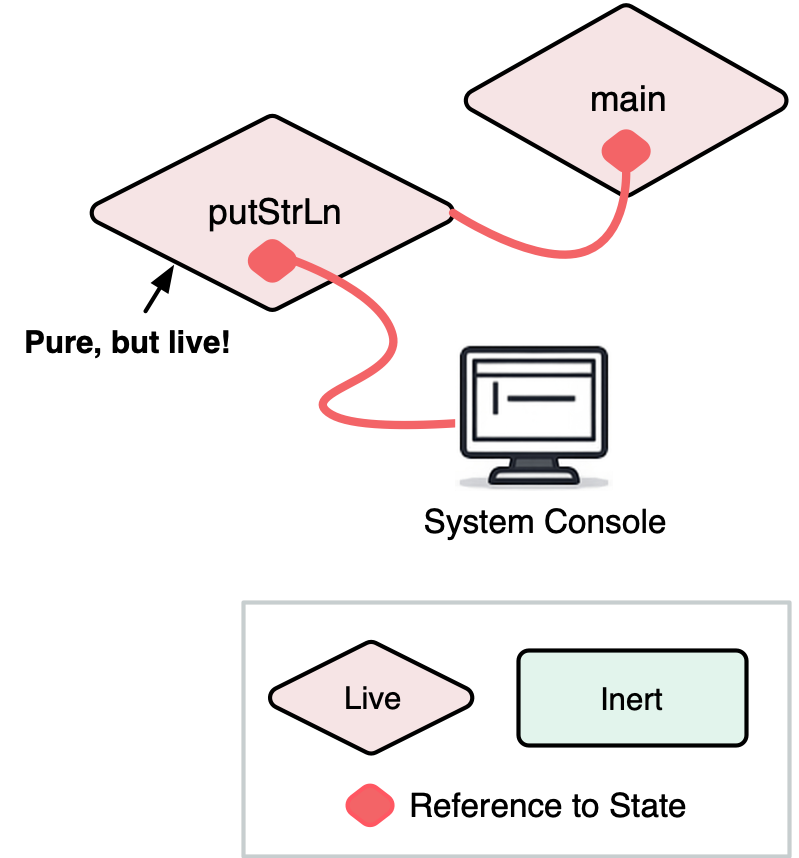
putStrLn is also live by the Mockability Test: it could be replaced by a function with the same type that redirects console writes to an in-memory buffer, without otherwise changing observable program behavior.
The Hermetic Alternative
Compare main with a version that parameterizes its access to the console using the tagless final pattern [Carette et al. 2009]:
| |
hermeticMain does not assume a particular console and does not commit to IO. The caller can supply either an in-memory mock or the real console through a live Console IO instance:
| |
So hermeticMain is both pure and inert, whereas main :: IO () is pure but live. Both sit in the “pure” row of the interaction-vs-access grid—but in different columns.
Toward Hermetic Haskell
Haskell’s Prelude and standard library contain many live identifiers: putStrLn, readFile, getCurrentTime. Any function that uses one of these becomes live. Liveness then propagates through composition, just as it does in imperative languages.
A “Hermetic Haskell” would move such live identifiers out of the Prelude and standard libraries, exporting only interfaces to system resources, with concrete implementations injected into main by the runtime. The ReaderT pattern can help manage the extra wiring [Snoyman 2017].
Purity guarantees that code does not interact with observable state when evaluated. Hermeticity guarantees that code does not have access to observable state unless authorized. A function can be pure but still hard-wired to the real filesystem, clock, or network. That is why patterns like tagless final and ReaderT are common in Haskell: not because Haskell is not pure enough, but because purity and hermeticity solve different problems.
Conclusion
When we think of “pure” data, we may imagine something cleanly serializable into a format like JSON. But the quality we are really reaching for is not purity but inertness. References, channels, closures, and effect values are the living machinery of computation, rooted in their execution environment. Integers, strings, and lists are inert matter being computed.
Hermeticity is inertness applied to functions. A hermetic function may not be pure, but it is pure functionality. Since it cannot access state directly, it must be plugged into live parameters to do anything in the world.
The inert/live distinction applies even in pure functional languages. Inert/live and pure/impure are independent axes of “clean.” Hermetic and functional programming are complementary.
Making a programming language hermetic is straightforward in principle: keep the ambient scope inert, export interfaces instead of live values from standard libraries, and inject concrete resources into the main function. Contexts or implicits can manage the extra wiring.
Parameterizing access to state carves programs at the joints. Hermetic functions are decoupled from free state, testable against mocks, portable, and composable. Function signatures are dependency manifests. All authority is explicit.
We should look back at global singletons or import fs granting immediate, permissions-based disk access with the same horror we feel for goto. The next generation of programming languages should be hermetic.
Hermetic programming links inversion of control, capability-based security, and local reasoning through a single semantic rule: a function may access existing state only through its parameters. No hard-coded dependencies. No ambient authority. No hidden inputs. No leaks.
Appendices
Appendix A: Hermeticity as Isolation
Etymology of “Hermetic”
The term hermetic has been used to describe a number of systems that isolate imperative code from its environment: most notably Google’s hermetic testing, hermetic servers, hermetic builds such as Bazel, and hermetic languages such as Wuffs and Starlark [Herbert 2010; Google Testing Blog 2012; Bazel; Wuffs; Starlark]. These all isolate effects to specifically authorized state: a test mock, a build artifact, the function’s arguments.
I have appropriated the term hermetic in this essay to mean isolation only with respect to access to state. But there are levels of isolation beyond hermeticity. For example, Wuffs programs are also isolated in the ACID sense, and they cannot spawn threads, allocate memory, or panic.
Call-Boundedness
A hermetic function might still spawn a goroutine or task that keeps interacting with state after the function has completed. It is still hermetic as long as the task interacts only with explicitly authorized state.
A function that uses structured concurrency ensures that all spawned threads complete before the function returns [Smith 2018]. I call such a function call-bound. Just as a pure function can use internal state that does not survive the call, a call-bound function may use internal concurrency that does not survive the call.
With call-bound hermetic functions, the function call is a boundary in both space and time: authority is granted to specific resources for the duration of the call only.
Atomicity
In a multithreaded environment with shared state, hermeticity does not guarantee isolation in the ACID sense: preventing concurrent processes from interleaving reads and writes.
A function call is atomic if, from the caller’s perspective, any state changes happen in a single instant—or not at all.
Containment
Hermeticity does not guarantee that a function will complete successfully: it may loop forever, run out of memory, panic, and so on.
A function is contained if it is guaranteed to return control to the caller without crashing the host process, regardless of input. This can be achieved through a language that prevents runtime panics, as Wuffs does, or through a runtime that sandboxes execution, as Erlang supervisors do.
Full Isolation
Hermeticity and call-boundedness are properties of the function definition itself, while atomicity and containment depend on the execution context. A function that is hermetic and call-bound, run in a context that guarantees atomicity and containment, could be considered fully isolated.
Appendix B: Restrictions on Access to State
The definitions of pure and hermetic functions lead to some initially surprising conclusions. For example, constructors that return live values can still be hermetic.
This appendix summarizes the different types of state and the restrictions on how pure and hermetic functions can access them.
Types of State
This essay defines state as anything that can affect or be affected by a computation in a way that is observable by normal program operations, ignoring timing, memory, and CPU usage. This is the same notion of observability typically used in definitions of purity and referential transparency. Equivalently, state is anything that, if interacted with, can make an expression non-referentially transparent.
State can exist before a function call (existing state) or be allocated during the call (fresh state).
Fresh state that does not escape the dynamic extent of the call is internal state.
Existing state, and fresh state that does escape the call, are observable state: their contents or identity may still matter after the function returns.
Grafting State
A function can expose state by writing a live value into existing state—for example, storing a reference in a mutable field or writing it to a channel—thereby making it reachable by other code without returning it. I call this grafting state.
Minting State
A hermetic function can expose fresh state that it allocates during the call. I call this minting state. Minting is why constructors can be hermetic: the minted state did not exist before the call, so the function is not accessing existing state. The function as a value remains inert.
Summary of Restrictions
| Capability | Pure | Hermetic |
|---|---|---|
| Access free state | Yes | No |
| Interact with observable state | No | Yes |
| Interact with internal state | Yes | Yes |
| Graft state | No | Yes |
| Mint state | No | Yes |
Appendix C: Glossary of Terms
- state: anything that can affect or be affected by a computation in a way that is observable by normal program operations
- To allocate state: to allocate memory that can be read and written
- existing state: state that existed before the function call
- fresh state: state allocated during the function call
- internal state: fresh state that does not escape the function call
- observable state: state, fresh or existing, that is observable outside the call
- parameterized state: state accessed through a live value received as a parameter
- free state: existing state that is not parameterized
- ambient state: free state accessible from ambient scope
- live: provides access to state, per the Mockability Test
- inert: not live
- interact: to affect or be affected by state
- access: to interact with or expose state
- expose: to provide access to state by returning or grafting a live value
- graft: to write a live value into observable state
- mint: to expose fresh state by causing it to escape
- pure: no interaction with observable state
- hermetic: no access to free state
- identifier: any binding or name-to-value association that can be referred to in a function definition
- live identifier: any identifier whose value is live
- free identifier, relative to a function definition: any identifier that is not a parameter or local variable
- ambient identifier: a free identifier available to all functions
- ambient scope: the collection of all ambient identifiers available to a function
Appendix D: The Mockability Test
We need a definition of live value that works in any language, without assuming object-capability discipline or appealing to less formal definitions of authority. The only thing we assume is an operational view of evaluation: running code can produce an interaction trace—a log of observable interactions with existing state, such as the filesystem, network, or clock, ignoring timing and resource usage.
The Trace-Projection Idea
A program’s interaction trace can be partitioned by which state it touches. If S is a particular existing state resource—or set of resources—such as a specific file, socket, clock, or region of memory, write:
π_S(trace)for the projection of a trace onto only the events that interact withS.
This lets us express “this program interacts with S” without talking about reference graphs or authority: it simply means π_S(trace) is non-empty.
Definition of Liveness
Let program contexts C[–] range over expression contexts: the hole may appear wherever an expression may appear, including in operator position, as in C[–] = (–)(x). This covers both read(x) and method-style calls once desugared: for example, x.read() selects some callable expression and then applies it.
A value v provides access to some existing state S iff:
There exists a substitute value
v′, admissible in place ofv, such that, for every program contextC[–]whose behavior does not depend on the representation identity of the value plugged into the hole—for example, its pointer address—the projected traces
π_S(trace(C[v]))andπ_{S′}(trace(C[v′]))are the same up to renaming of state identities, where
S′ranges over fresh caller-allocated internal state disjoint fromS.
And:
vis live iff it provides access to some existing stateS.
Intuitively: v provides access to S if whatever interactions a program can have with S can always be retargeted, by swapping v for v′, to an isomorphic interaction with state that the caller allocates and controls.
Why “Internal State” Matters
The requirement that S′ range over the caller’s internal state is the true test of whether a value really provides access to state, rather than merely designating it. For example, if the caller of read(filehandle) can redirect reads to a different file but cannot redirect them to an in-memory mock, then the filehandle token is just a designator. The live part is whatever operation interprets that token—such as read or filehandle.read —because that is what must be substituted to retarget the interaction to caller-controlled internal state.
If, on the other hand, read accepts an interface, trait, or function that the caller can implement, then the caller can substitute a behavioral equivalent that routes reads not just to a different file, but to any internal state the caller controls. In that case, the file handle value itself is live.
Pointers Are Live
A pointer to mutable state is live under this test because it is retargetable: in any context that treats pointers extensionally, rather than inspecting their numeric addresses, a pointer to one region can be substituted with a pointer to a fresh region, yielding an isomorphic interaction trace over that region.
This remains true even in a memory-unsafe language where pointers are forgeable from integers. That is not a contradiction: liveness is about whether a value can serve as a retargetable conduit to state. Hermeticity is a stronger language property: it requires eliminating ambient ways to obtain conduits. In a language like C, the dereference operator (*) and integer-to-pointer casts act as ambient authority over memory.
A hermetic programming language must therefore make live values unforgeable—that is, it must provide some form of memory safety or capability safety—so that a program cannot conjure access to arbitrary memory out of thin air.
Appendix E: Closures and Methods
Closures
A closure that captures a live value is itself live and therefore not hermetic. However, a function that receives a live closure as a parameter can still be hermetic: the state access is parameterized by the closure value. Similarly, a hermetic function can create and return a new closure, as long as that closure does not capture any live free identifiers relative to the enclosing function’s body.
Since all package-scoped functions are inert in a hermetic programming language, the only way a live function can enter a program is as a locally scoped closure or nested function that captures live local variables.
Methods
Methods can be thought of as functions parameterized by their receivers. A method that only interacts with state reachable through its receiver and other parameters is hermetic: the object is live, not the method.
Consider an object that embeds a reference to a logger. If one of the object’s methods writes to that logger, and only to that logger, the method is hermetic. On the other hand, if the method hard-codes access to a global logger instead of the one embedded in the object, then the method itself is live.
It follows that in a hermetic programming language, exported types must be hermetic in the sense that they cannot have live methods.
Notes
References
[Bazel] Bazel documentation, Hermeticity. https://bazel.build/basics/hermeticity
[Benfield 2017] Cory Benfield, Sans-IO: Network Protocol Libraries in Python (2017). https://sans-io.readthedocs.io/
[cap-std] Bytecode Alliance, cap-std: capability-based standard library for Rust. https://github.com/bytecodealliance/cap-std; https://docs.rs/cap-std
[Carette et al. 2009] Jacques Carette, Oleg Kiselyov, and Chung-chieh Shan, Finally Tagless, Partially Evaluated: Tagless Staged Interpreters for Simpler Typed Languages (Journal of Functional Programming, 2009). https://okmij.org/ftp/tagless-final/JFP.pdf
[Finifter et al. 2008] Matthew Finifter, Adrian Mettler, Naveen Sastry, and David Wagner, Verifiable Functional Purity in Java (CCS 2008), pp. 161–174. https://people.eecs.berkeley.edu/~daw/papers/pure-ccs08.pdf
[Fowler 2004] Martin Fowler, Inversion of Control Containers and the Dependency Injection pattern (2004). https://martinfowler.com/articles/injection.html
[Go net/http docs] Go standard library documentation, net/http.Serve. https://pkg.go.dev/net/http#Serve
[Google Testing Blog 2012] Google Testing Blog, Hermetic Servers (2012). https://testing.googleblog.com/2012/10/hermetic-servers.html
[Herbert 2010] Scott Herbert, Benefits of Hermeticity (2010). https://slaptijack.com/programming/benefits-of-hermeticity.html
[hyper-h2] Python Hyper Project, hyper-h2. https://github.com/python-hyper/h2
[Lampson 1973] Butler W. Lampson, A Note on the Confinement Problem (Communications of the ACM, 1973). https://www.cs.cornell.edu/andru/cs711/2003fa/reading/lampson73note.pdf
[Mettler et al. 2009] Adrian Mettler, Tyler Close, and David Wagner, Joe-E Specification (2009). https://people.eecs.berkeley.edu/~daw/joe-e/spec-20090918.pdf
[Miller 2006] Mark S. Miller, Robust Composition: Towards a Unified Approach to Access Control and Concurrency Control (2006). https://www.erights.org/talks/thesis/markm-thesis.pdf
[Miller and Shapiro 2003] Mark S. Miller and Jonathan S. Shapiro, Paradigm Regained: Abstraction Mechanisms for Access Control (ASIAN 2003), pp. 224–242. http://www.erights.org/talks/asian03/paradigm-revised.pdf
[Peyton Jones 2001] Simon Peyton Jones, Tackling the Awkward Squad: monadic input/output, concurrency, exceptions, and foreign-language calls in Haskell (2001). https://www.microsoft.com/en-us/research/wp-content/uploads/2016/07/mark.pdf
[Reynolds 1972/1998] John C. Reynolds, Definitional Interpreters for Higher-Order Programming Languages (originally presented 1972; reprinted 1998). https://link.springer.com/content/pdf/10.1023/A:1010027404223.pdf
[Endo SES] Endo, SES (Hardened JavaScript). https://github.com/endojs/endo/blob/master/packages/ses/README.md
[Smith 2018] Nathaniel J. Smith, Notes on structured concurrency, or: Go statement considered harmful (2018). https://vorpus.org/blog/notes-on-structured-concurrency-or-go-statement-considered-harmful/
[Snoyman 2017] Michael Snoyman, The ReaderT Design Pattern (2017). https://www.fpcomplete.com/blog/readert-design-pattern/
[Starlark] Bazel Build, Starlark. https://github.com/bazelbuild/starlark
[Wagner 2007] David Wagner, TRUST07 slides on Joe-E. https://people.eecs.berkeley.edu/~daw/talks/TRUST07.pdf
[WASI] WebAssembly System Interface, Capabilities. https://wasi.dev; https://github.com/WebAssembly/WASI/blob/main/docs/Capabilities.md
[Wuffs] Google, Wuffs: Wrangling Untrusted File Formats Safely. https://github.com/google/wuffs
[Yee et al. 2003] Ka-Ping Yee, Mark S. Miller, and Jonathan Shapiro, Capability Myths Demolished (Systems Research Laboratory Technical Report SRL2003-02, Johns Hopkins University, 2003). https://srl.cs.jhu.edu/pubs/SRL2003-02.pdf
As usual, we ignore changes not observable by normal program operations, such as internal allocation, garbage collection, caching, or timing effects. Allocating fresh state is internal to the call unless it escapes, assuming ordinary memory safety. ↩︎
Joe-E defines immutable objects transitively: their fields, and objects reachable from them, must not change after construction. Such objects are inert in the sense used here, though inert is broader than Joe-E’s object-graph formulation and is not limited to object-oriented languages [Mettler et al. 2009]. ↩︎
The closures-as-objects view is the language-design analog of defunctionalization [Reynolds 1972/1998]. ↩︎
Miller, Yee, and Shapiro identify Property F: Access-Controlled Delegation Channels: authority flows only along channels that are themselves access-controlled [Yee et al. 2003]. ↩︎
The classic confinement problem is ensuring that a program cannot transmit information except through authorized channels [Lampson 1973]. ↩︎